UK Economy Grows 0.3% in June as Services Drive Second-Quarter Expansion
Monthly GDP rose 0.3% in June and 0.4% across the second quarter, led by services, though the outlook stays exposed to energy prices.
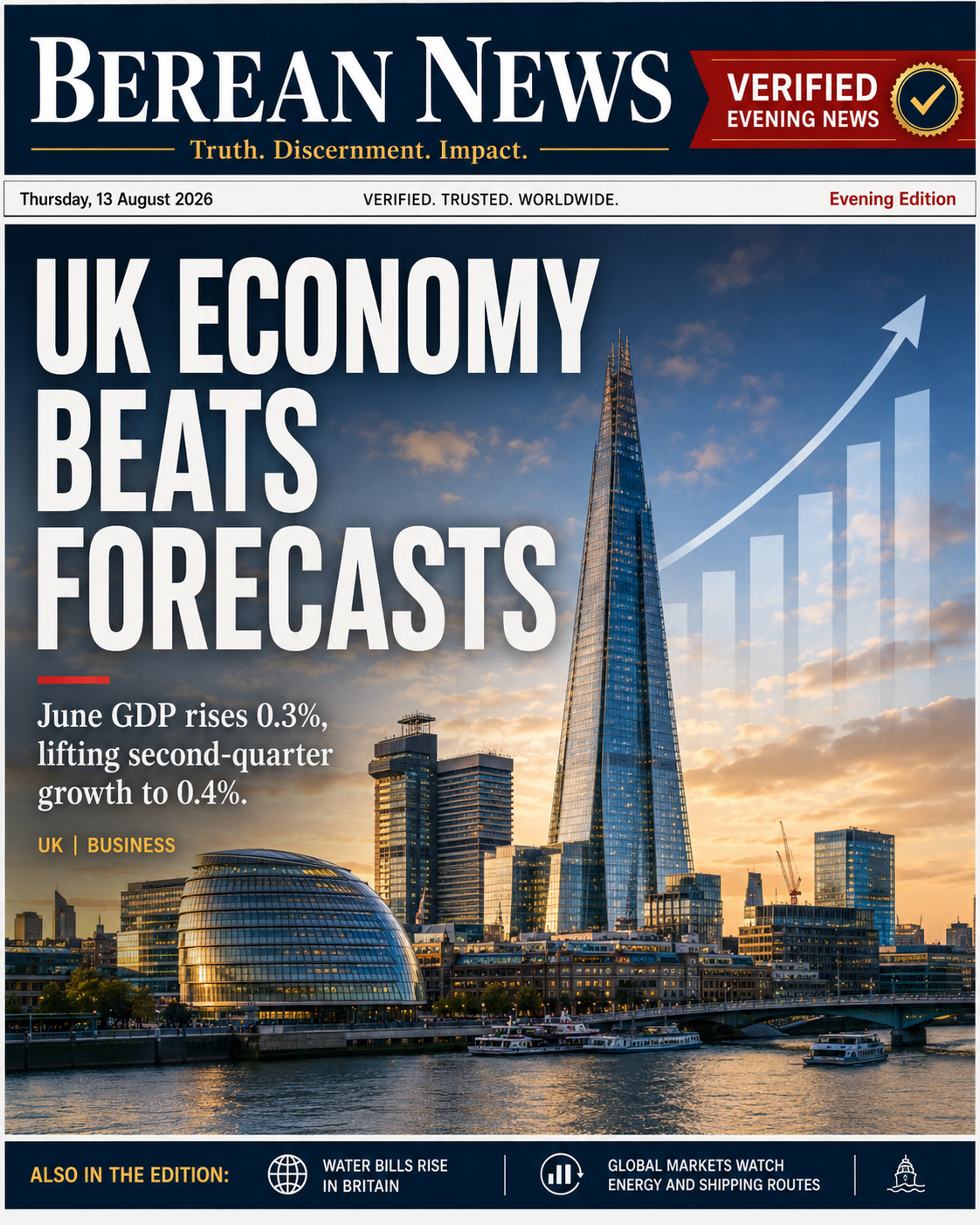
LONDON — Britain’s economy expanded more strongly than expected in June, providing a measure of economic resilience even as households and businesses confront high energy costs, inflation pressures and international uncertainty.
The Office for National Statistics estimates that monthly gross domestic product increased 0.3% in June, after no growth in May and a 0.1% decline in April.
Services were responsible for the June expansion, growing by 0.4%. Production fell by 0.2%, while construction declined by 0.1%. Eight of the 14 major services subsectors recorded growth during the month.
Across the entire April-to-June quarter, real GDP increased by 0.4%, slowing from 0.6% growth in the first quarter. Services rose 0.5%, construction increased 0.3%, while production recorded no overall quarterly growth.
GDP was 1.2% higher than in the same quarter a year earlier, while real GDP per head increased 0.4% during the quarter and was 1% above its year-earlier level.
Information and communication services were among the strongest areas. Output in that sector increased 2.7% during the quarter, including a 3.7% rise in computer programming, consultancy and related activities. Professional, scientific and technical services also grew strongly.
Reuters attributed part of June’s improvement to factors including temporary easing of energy pressures, warm weather and consumer activity around the men’s football World Cup.
The figures are encouraging but do not guarantee continued strong growth. Energy costs remain vulnerable to the Iran conflict and disruption around Hormuz. Inflation and household bills may rise further, while economists expect the economy to lose some momentum later in the year. The ONS also stresses that early GDP figures are estimates and can be revised as additional information becomes available.
The balanced evening interpretation is therefore straightforward: Britain performed better than expected at the end of the second quarter, but the outlook remains exposed to energy prices, inflation and global instability.
Sources: UK Office for National Statistics; Reuters, 13 August 2026.
Corrections & updates
- Story updatedAug 27, 2026, 1:52 PM
- Story published
Verified against the sources cited in this report.
Aug 13, 2026, 5:37 PM
Related stories

UK Car Market Extends Recovery as August Sales Jump 13.7%
August marks the strongest performance since 2018, with a ninth consecutive month of growth and battery-electric registrations up 27.7%.
UK Business Confidence Reaches Four-Month High, but Global Risks Threaten Recovery
Confidence among British businesses rose to a four-month high in July as companies became more optimistic about the economy and experienced some relief from energy and operating-cost pressures.

Global interest rates move higher as energy pressure complicates inflation fight
The US Federal Reserve stands at 3.75–4.00%, the Bank of Japan has raised rates to 1.25%, the Bank of England held at 3.75% by 6–3 and the ECB remains on a tightening path.