World Hepatitis Day Highlights Preventable Liver-Cancer Deaths and Gaps in Care
World Hepatitis Day is being marked with renewed calls for governments to expand vaccination, testing and treatment as viral hepatitis continues to cause preventable liver disease, cancer and death.
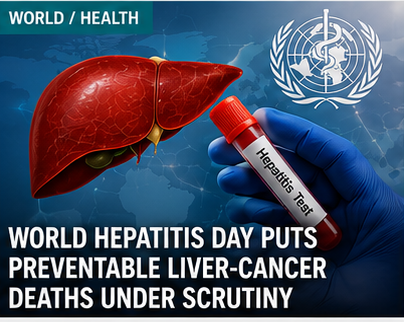
GENEVA — Governments and health organisations are being urged to remove the financial, social and health-system barriers preventing millions of people from receiving hepatitis prevention, diagnosis and treatment.
World Hepatitis Day 2026 is being observed under the theme "Hepatitis: Let's Break It Down." The World Health Organization says the campaign is intended to challenge stigma, limited awareness, fragmented services, financial obstacles and inequalities that keep lifesaving care out of reach.
WHO estimates that 287 million people were living with chronic hepatitis B or C in 2024. Approximately 1.3 million people died from the two infections during the same year, while only 45% of babies worldwide received a hepatitis B vaccine dose within 24 hours of birth.
Viral hepatitis causes inflammation of the liver. Although several forms may produce short-term illness, hepatitis B, C and D can become chronic and lead to cirrhosis, liver failure and cancer. The International Agency for Research on Cancer classifies these three infections as carcinogenic to humans.
IARC estimates that almost 850,000 people were diagnosed with liver cancer worldwide in 2024 and more than 730,000 died from the disease. Chronic infection with viral hepatitis is a major contributor to this burden.
The continuing loss of life is especially concerning because effective medical tools already exist. Hepatitis B can be prevented through vaccination. Antiviral treatment can suppress hepatitis B and reduce the risk of serious liver disease, while modern medicines can cure most hepatitis C infections.
One of the greatest challenges is that hepatitis may remain silent for years. People can feel healthy while liver damage develops, meaning diagnosis may come only after cirrhosis or cancer has appeared. Wider screening is therefore essential, particularly among people with known exposure risks and in communities with a high burden of infection.
A high-level event organised by the Government of Brazil and WHO is taking place at AIDS 2026 in Rio de Janeiro. Ministers, technical experts, civil-society representatives and affected communities are expected to discuss financing, service delivery, innovation and equitable access.
IARC representatives are also participating in a World Hepatitis Day event hosted by Egypt's Ministry of Health and Population in Cairo, where the relationship between chronic hepatitis and liver cancer will be highlighted.
The central public-health question is no longer whether viral hepatitis can be prevented and treated. It is whether governments will invest enough to ensure that vaccination, testing and medicines reach people before irreversible liver damage occurs.
Source attribution: World Health Organization and International Agency for Research on Cancer.
Corrections & updates
- Story updatedJul 28, 2026, 8:02 AM
- Story published
Verified against the sources cited in this report.
Jul 28, 2026, 7:35 AM
Related stories

WHO Warns Attacks on Healthcare Are Becoming a Global Crisis
More than 900 attacks on hospitals, medical workers and health infrastructure have been documented in 2026, with consequences that outlast each incident.
WHO Calls for Integrated Services to Restore Progress Against HIV, Hepatitis and STIs
A new WHO assessment says the world remains off track for the 2030 targets and calls for integrated care, stronger surveillance, sustained financing and community leadership.

Children exposed to 9/11 to receive major long-term health study
United States health authorities have funded a multi-year study of people who were children in lower Manhattan in 2001, twenty-five years on.