WHO Experts Say Simulation Training Should Become Part of Health Systems
Health leaders say realistic simulation can improve patient safety, teamwork, emergency readiness and the resilience of national health services.
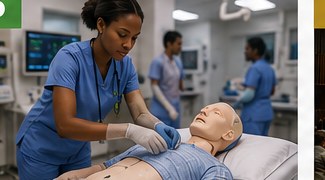
LYON — Simulation-based training should be integrated into national health systems rather than treated as an occasional educational activity, according to experts brought together by the World Health Organization.
More than 80 representatives from health ministries, hospitals, universities, professional associations, international organisations, simulation societies and industry partners met at the WHO Academy in Lyon, France, to consider how simulation could strengthen the global health workforce.
The event was organised by WHO and the Society for Simulation in Europe. Participants examined ways to move simulation from isolated local projects into national health policy, workforce planning and professional education.
Simulation recreates clinical emergencies and other complex healthcare situations in controlled environments. Medical teams can practise procedures, communication, decision-making, leadership and teamwork without placing real patients at risk.
Participants concluded that simulation can strengthen health systems by improving quality of care, patient safety, workforce preparedness, team performance and organisational resilience.
The approach can be used to prepare staff for resuscitation, childbirth emergencies, infectious-disease outbreaks, mass-casualty events and routine clinical procedures. It can also reveal weaknesses in communication, equipment availability and hospital processes before those failures affect real patients.
Although evidence supporting simulation has grown, implementation remains fragmented. Many initiatives depend on individual hospitals, universities or local leaders and may disappear when funding or leadership changes.
Experts said long-term impact will require simulation to be included in national education systems, healthcare budgets, professional standards and workforce-development plans. Governments, academic institutions, hospitals and international organisations will need to cooperate if the approach is to operate at scale.
Simulation does not always require expensive virtual-reality equipment or advanced laboratories. Programmes can also use trained actors, basic medical models, structured scenarios and ordinary clinical spaces.
This is particularly important for countries and communities with limited financial resources. Affordable approaches can still help workers practise communication, emergency decision-making and coordinated care.
WHO said health systems worldwide face staff shortages, increasingly complex care and rapidly changing competency requirements. The central issue is therefore no longer whether simulation has value, but how it can be financed, expanded and sustained.
WHO and the Society for Simulation in Europe are expected to consolidate the meeting's recommendations and priorities into a joint report.
Corrections & updates
- Story updatedAug 27, 2026, 1:52 PM
- Story published
Verified against the sources cited in this report.
Jul 22, 2026, 7:25 AM
Related stories

WHO Presents First Proposed Global Standards for Long-Term Care
The proposed framework seeks to improve dignity, safety, staffing and accountability in services supporting older people at home, in communities and in residential facilities.
WHO Calls for Integrated Services to Restore Progress Against HIV, Hepatitis and STIs
A new WHO assessment says the world remains off track for the 2030 targets and calls for integrated care, stronger surveillance, sustained financing and community leadership.
WHO Introduces New Regulatory Path to Speed Access to Safe Medical Devices
A new interim list of trusted medical-device regulators is designed to help countries rely on established assessments and reduce unnecessary duplication.