South Sudan's President Dismisses Central Bank Governor and Reappoints Former Office-Holder
Salva Kiir has removed Johnny Ohisa as governor of the Bank of South Sudan and reappointed Addis Ababa Othow amid oil revenue losses, inflation and currency pressure.
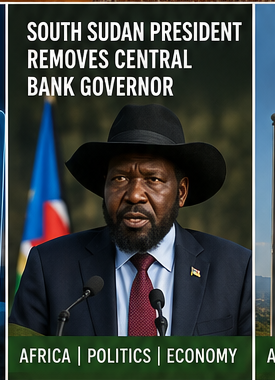
South Sudanese President Salva Kiir has dismissed central-bank governor Johnny Ohisa and appointed former governor Addis Ababa Othow as his replacement.
The leadership change was announced in a presidential decree read on state broadcasting late on Wednesday. No official explanation was provided for Ohisa's removal.
Othow previously served as governor of the Bank of South Sudan between June and November 2025. His return places him once again in charge of monetary policy at a particularly difficult time for the country's economy.
Ohisa, an economist who had held the position on several occasions, was most recently reappointed earlier in 2026.
The dismissal forms part of a broader series of senior personnel changes made by Kiir across the government and security establishment.
Political analysts have interpreted the repeated reshuffles as evidence of efforts to strengthen control within the administration amid uncertainty surrounding the country's political succession and delayed transition.
The immediate economic challenge facing the new governor will be stabilising a system under severe pressure from reduced oil income, inflation, cash shortages and currency depreciation.
Oil is South Sudan's main source of government revenue and foreign exchange. Disruption to production or export routes therefore has an immediate effect on public finances, the availability of foreign currency and the government's ability to pay salaries.
A weaker national currency can also raise the domestic price of imported food, fuel and essential goods, placing additional pressure on households already facing widespread poverty and humanitarian need.
The central bank will be expected to manage liquidity, currency circulation and exchange-rate instability while attempting to restore public confidence in the financial system.
However, the bank's effectiveness will depend partly on wider government policy, oil revenues, fiscal discipline and political stability. Monetary measures alone are unlikely to resolve structural problems affecting the economy.
Repeated changes at the top of the central bank may also concern businesses and development partners seeking consistency and predictability in economic policy.
South Sudan gained independence in 2011 but descended into civil war in 2013. Although a peace agreement reduced nationwide fighting, implementation of political and institutional reforms has repeatedly been delayed.
The government has also struggled to manage corruption concerns, weak institutions, humanitarian crises and instability in different parts of the country.
Othow's appointment will therefore be judged not only by whether he can slow currency depreciation and inflation but also by whether the central bank can demonstrate greater institutional credibility during a politically sensitive period.
Corrections & updates
- Story updatedJul 30, 2026, 12:17 PM
- Story published
Verified against the sources cited in this report.
Jul 30, 2026, 12:07 PM
Related stories
UK borrowing costs hit levels not seen since before financial crisis
The ten-year gilt yield closed at 5.378 per cent, tightening the fiscal squeeze ahead of the autumn budget.

Tonight's editorial picture: the cost of building faster than we can check
Artificial intelligence, energy and a hillside fire in Bukavu look unrelated. Read together, they describe a world building at a speed its safeguards have not matched.

Strong US Jobs Report Shakes Markets as Rate-Hike Bets Surge
Investors reassess rate expectations as markets respond to stronger employment data, with the dollar and bond yields climbing.