Russian Soviet-era film screening in Taipei alarms Taiwan
A private screening for around 20 people has become a geopolitical controversy as Taiwanese officials point to a broader information campaign.

TAIPEI — A private screening attended by only around 20 people has become an unexpected geopolitical controversy after Taiwanese security officials interpreted the showing of an 81-year-old Soviet documentary as part of a broader Russian and Chinese information campaign.
Russian officials in Taipei screened an old documentary about the Soviet Union's defeat of Japanese forces at the end of the Second World War. The event included Chinese-language material and was organised by Russia's de facto diplomatic representation in Taiwan.
On its face, a screening for approximately 20 guests would ordinarily attract little international attention.
Taiwan's government, however, believes it fits into a broader narrative increasingly promoted by Beijing and Moscow portraying modern Japan as a potential military threat and emphasising Japanese wartime aggression.
The issue has become especially sensitive because Japan has strengthened defence ties with the United States and has increasingly discussed what role it might play if China attempted to take Taiwan by force.
Taiwanese officials fear that historical narratives could be used as part of cognitive warfare — efforts to influence public opinion, increase distrust of democratic partners and weaken Taiwan's relationships with Japan and Western nations.
Taiwan's National Security Council says it is monitoring expanding Chinese-Russian cooperation in military and information operations. Taipei simultaneously stresses that Taiwan is a democracy and does not intend to suppress lawful expression merely because it dislikes the message.
China dismissed Taiwan's concerns as politically motivated anti-China rhetoric.
The controversy provides a useful illustration of modern geopolitical competition: propaganda does not always involve millions of viewers. Sometimes the purpose of an event may be to introduce or amplify a particular narrative that can then spread far beyond the original audience.
Corrections & updates
- Story updatedSep 11, 2026, 3:11 PM
- Story published
Verified against the sources cited in this report.
Sep 11, 2026, 2:50 PM
Related stories
Xi–Modi meeting being arranged as BRICS summit opens new diplomatic test
China's foreign ministry says a bilateral meeting is being arranged during the New Delhi summit; it has not yet taken place.

Ukraine's long-range drones reach Russia's Arctic gas heartland
Ukrainian special forces say they struck two gas-condensate facilities in Yamal-Nenets, around 3,000km away. Russian authorities confirmed a fire at Novy Urengoy but not every element of Kyiv's account.
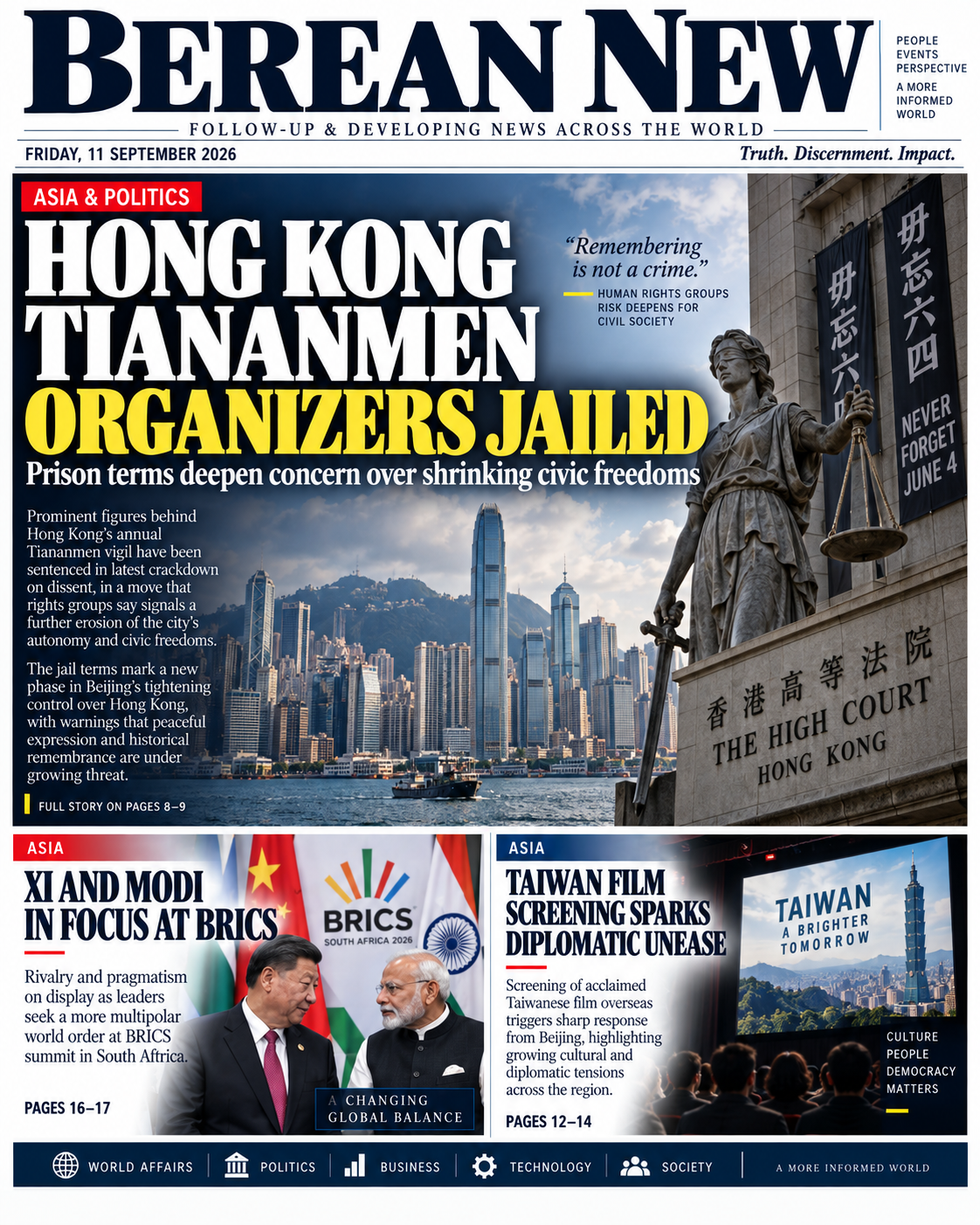
Hong Kong jails Tiananmen vigil leaders under national security law
Lee Cheuk-yan was sentenced to seven years and Chow Hang-tung to seven years and three months for inciting subversion.