Woolworths Warns Profit Growth Is Slowing as Consumers Face Higher Costs
The South African retailer expects headline earnings per share to rise between 2.5% and 7.5% for the 52 weeks to 28 June, after second-half trading slowed.
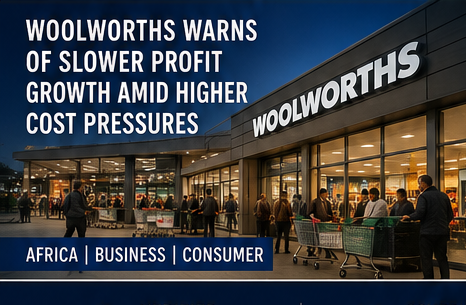
South African retailer Woolworths Holdings has warned that its annual profit is likely to record only modest growth after difficult trading conditions weakened consumer demand during the second half of its financial year.
The company said headline earnings per share for the 52 weeks ending 28 June were expected to increase by between 2.5% and 7.5%.
That would place headline earnings per share between 274.8 cents and 288.2 cents, compared with 268.1 cents during the previous year.
Headline earnings per share is a widely used measure of operating performance among companies listed in South Africa because it excludes certain once-off gains and losses.
Group turnover and concession sales increased by 4.3%, or 4.8% when currency movements were excluded. Growth slowed to 3.3% during the second half of the year, however, reflecting increasing pressure on consumers.
Woolworths attributed the softer performance to inflation, higher fuel costs and increased interest rates associated with instability and conflict in the Middle East.
Higher energy and transport costs affect retailers in several ways. They increase the cost of moving goods through supply chains, raise household expenses and reduce the disposable income available for clothing, household goods and other discretionary purchases.
Woolworths South Africa reported turnover and concession-sales growth of 5.4%. Its food division increased sales by 5.7%, while fashion, beauty and home sales rose by 4.4%.
The food business remains an important source of resilience for the group, although food inflation and pressure on household budgets could influence customers' purchasing choices.
The fashion, beauty and home division experienced pressure on margins because of promotional activity and efforts to clear excess inventory. Discounting can help retailers move unsold stock, but it also reduces the profit earned on each item and can weaken overall margins.
In Australia and New Zealand, Woolworths-owned Country Road Group recorded annual sales growth of 1%. Sales in the second half declined by 0.5%. Country Road nevertheless returned to full-year profitability after reducing operating costs and exercising tighter control over discounts.
The figures show that Woolworths continues to grow, but at a slower rate and under more difficult economic conditions. Its performance provides a broader indication of the health of consumer spending in South Africa, Australia and New Zealand.
The company's outlook will depend on inflation, interest rates, employment conditions, fuel prices, currency movements and whether consumers regain confidence during the next financial year.
For South African households, the update reinforces evidence that rising living costs are forcing shoppers to prioritise essential goods while limiting discretionary spending.
For investors, the key question is whether Woolworths can protect margins and maintain sales without relying excessively on discounts in an increasingly cautious consumer market.
Corrections & updates
- Story updatedJul 30, 2026, 12:17 PM
- Story published
Verified against the sources cited in this report.
Jul 30, 2026, 12:04 PM
Related stories

Oracle revenue jumps 30% as AI cloud backlog reaches $664 billion
Contracted future revenue from artificial intelligence infrastructure has grown to a scale that now shapes the whole cloud market - and raises questions about how much of it converts.

Lenovo Revenue Climbs as AI Server Orders Offset Weak Consumer PC Market
The world's largest personal-computer maker reported higher revenue as infrastructure sales grew faster than its consumer division, underlining how far the AI build-out has shifted the industry's centre of gravity.

Cisco Points to AI Data Centres as Networking Orders Strengthen
The networking group reported stronger orders from cloud and enterprise customers, saying the switching and optics required to connect AI clusters has become a distinct source of demand.