China's SMIC Raises Chip Prices as Artificial-Intelligence Demand Strains Capacity
SMIC has increased prices for its most sought-after capacity, with utilisation at 93.7% and quarterly revenue above $3 billion for the first time.
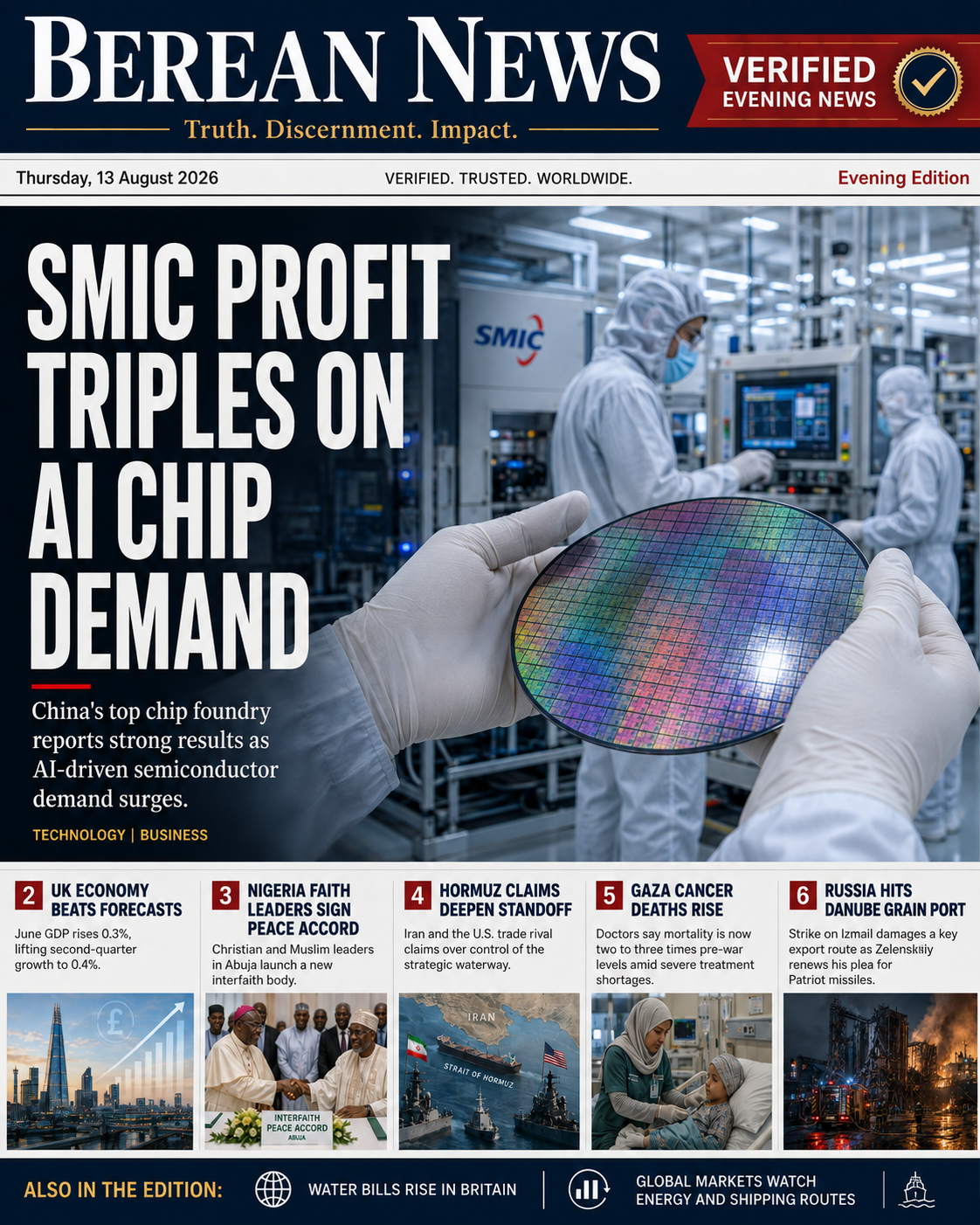
BEIJING — China's largest semiconductor manufacturer has raised prices for some of its most sought-after production capacity as booming demand for artificial-intelligence hardware adds pressure to global chip supplies.
Semiconductor Manufacturing International Corporation, better known as SMIC, said AI-related orders remain strong and are expected to support demand throughout the second half of 2026.
The company generated more than $3 billion in quarterly revenue for the first time during the second quarter.
Profit attributable to shareholders tripled to $479.2 million, although part of the increase came from a one-off gain involving a subsidiary.
SMIC shipped approximately 2.9 million eight-inch-equivalent wafers during the quarter, 14% more than during the preceding three months.
Average wafer selling prices increased 5.7%.
SMIC is particularly important to China's efforts to reduce dependence on foreign semiconductor manufacturing.
It is currently China's only foundry able to mass-produce advanced logic chips such as CPUs and GPUs using a 7-nanometre production process.
Company executives said much of the latest demand is coming from AI-related chips other than CPUs and GPUs, particularly among Chinese customers.
SMIC's factories are operating close to capacity, with utilisation reaching approximately 93.7%.
The company says it will accelerate new production lines and adjust capacity to reduce bottlenecks.
SMIC expects third-quarter revenue to grow another 2%-4% from the second quarter.
The development illustrates a broader consequence of the artificial-intelligence boom: demand is extending beyond the most advanced Nvidia-style accelerators into memory, networking, power-management and other semiconductor categories.
That is placing pressure on manufacturing capacity across the industry and giving chip producers greater ability to increase prices.
Corrections & updates
- Story updatedAug 14, 2026, 10:06 AM
- Story published
Verified against the sources cited in this report.
Aug 14, 2026, 8:46 AM
Related stories
Nvidia Enters Washington's Political Arena With Employee-Funded PAC
The AI chipmaker is preparing to establish NVPAC as export controls, tariffs and data-centre policy increasingly shape its business.

Nvidia Says AI Boom Still Has Years to Run as It Forecasts 70% Sales Growth
The chipmaker's outlook for roughly 70% revenue growth next fiscal year lifted technology shares and eased fears of a sharp slowdown in AI infrastructure spending.
US Circulates Draft AI Pact to 35 Countries as Competition With China Sharpens
State Department letters propose shared standards and export alignment on advanced chips, in what officials describe internally as a technology bloc.