Samsung and Broadcom Announce AI-Chip Partnership Valued at More Than $200 Billion
The memorandum of understanding covers advanced memory, contract chip manufacturing and packaging technologies through 2030, as demand for specialised AI processors continues to rise.
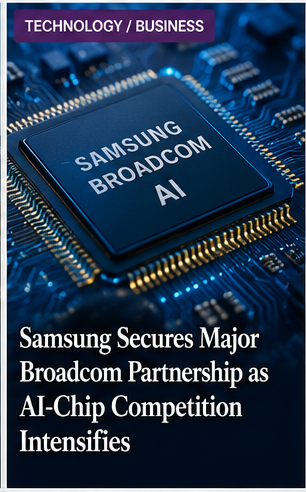
SEOUL — Samsung Electronics and US chip designer Broadcom have announced an expanded semiconductor partnership that the companies estimate could exceed $200 billion through 2030.
The memorandum of understanding covers advanced memory products, foundry manufacturing and chip-packaging technologies intended for next-generation artificial-intelligence and high-performance-computing infrastructure.
The agreement was announced during an AI summit in San Francisco attended by senior executives from both companies and representatives of the South Korean Government.
Broadcom designs customised semiconductors used in networking, communications and AI systems, while Samsung operates across memory manufacturing, contract chip production and advanced packaging.
The partnership is expected to combine Broadcom's chip-design capabilities with Samsung's ability to manufacture several types of semiconductor components within the same industrial group.
Demand for specialised AI chips has increased rapidly as technology companies build data centres and develop their own customised accelerators rather than relying entirely on general-purpose graphics processors.
For Samsung, the arrangement could improve utilisation at advanced manufacturing facilities and strengthen its position against competitors in foundry and high-bandwidth-memory markets.
The announcement should nevertheless be interpreted carefully. A memorandum of understanding establishes planned cooperation but does not necessarily guarantee that the full estimated value will become firm revenue.
The commercial result will depend on product development, manufacturing yields, customer demand, pricing, technology performance and the wider semiconductor market.
The partnership also reflects concerns about concentration in global chip supply. AI infrastructure currently depends on a relatively small number of manufacturers and specialist suppliers, creating vulnerabilities when demand exceeds capacity or geopolitical tensions disrupt production.
Expanding production options may strengthen supply resilience, although the industry will remain dependent on highly specialised equipment, materials and expertise distributed across several countries.
Samsung's collaboration with Broadcom forms part of a wider wave of investment involving South Korean semiconductor companies and major US technology groups.
The agreement highlights the scale of spending now being directed towards AI infrastructure. Investors and regulators will continue examining whether that growth is sustainable and whether rising demand produces wider benefits beyond the largest technology companies.
Corrections & updates
- Story updatedJul 27, 2026, 7:07 AM
- Story published
Verified against the sources cited in this report.
Jul 27, 2026, 6:00 AM
Related stories

Nvidia Says AI Boom Still Has Years to Run as It Forecasts 70% Sales Growth
The chipmaker's outlook for roughly 70% revenue growth next fiscal year lifted technology shares and eased fears of a sharp slowdown in AI infrastructure spending.
Oracle revenue jumps 30% as AI cloud backlog reaches $664 billion
Contracted future revenue from artificial intelligence infrastructure has grown to a scale that now shapes the whole cloud market - and raises questions about how much of it converts.

Nvidia Enters Washington's Political Arena With Employee-Funded PAC
The AI chipmaker is preparing to establish NVPAC as export controls, tariffs and data-centre policy increasingly shape its business.