Congo and Rwanda Clash Over Proposed Disarmament of FDLR Rebels
Kinshasa says the FDLR has signed a protocol committing to disarmament and cantonment. Kigali rejects the arrangement as inconsistent with the US-brokered peace framework.
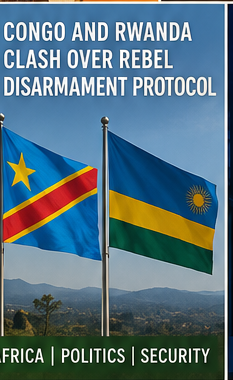
The Democratic Republic of Congo and Rwanda have exchanged sharply different interpretations of a proposed agreement intended to disarm the Democratic Forces for the Liberation of Rwanda, an armed group operating in eastern Congo.
Congolese authorities said the FDLR had signed a protocol committing in principle to disarmament, demobilisation and relocation to designated cantonment sites.
Rwanda rejected the arrangement, describing it as inconsistent with the peace framework brokered by the United States between the neighbouring countries.
The FDLR was founded by ethnic Hutu fighters, including individuals linked to forces responsible for the 1994 genocide against the Tutsi in Rwanda. It has operated in eastern Congo for decades.
Kigali regards the group as a serious security threat and has repeatedly accused Congolese authorities of cooperating with it.
Kinshasa, in turn, accuses Rwanda of supporting the AFC/M23 rebellion, which has seized territory and fought Congolese forces in the east. Rwanda has disputed allegations regarding its role, although international experts have repeatedly documented links between Kigali and M23.
The status of the FDLR is one of the central issues in the peace agreement signed by Congo and Rwanda in Washington.
That framework provides for the neutralisation of the FDLR and the disengagement of Rwandan forces from Congolese territory. Progress against the rebel organisation is therefore considered a major test of whether the broader agreement can be implemented.
Under the protocol reported by Congolese authorities, FDLR members would agree to disarm, demobilise and move to cantonment sites. The arrangement also refers to security guarantees and protection against forced extradition to Rwanda.
Important details remain unresolved. The document does not establish how many fighters are covered, where the cantonment sites will be located, when weapons will be surrendered or whether any combatants have already begun complying.
Congolese government spokesperson Patrick Muyaya said the protocol was compatible with the Washington agreement and represented progress towards meeting Congo's obligations.
Rwandan Foreign Minister Olivier Nduhungirehe rejected that interpretation, arguing that the peace agreement requires the FDLR to be neutralised rather than treated as a party entitled to negotiate conditions.
That disagreement exposes a fundamental divide between the two governments. Congo appears to favour a managed disarmament process involving negotiations and guarantees, while Rwanda is demanding a more direct dismantling of the organisation.
Verification will be critical. A credible process would need independent monitoring of fighter numbers, surrendered weapons, movements to cantonment sites and the treatment of civilians living in affected areas.
The dispute could weaken the wider peace process if the parties cannot agree on the meaning of "neutralisation" or on the sequence linking FDLR disarmament to the withdrawal of Rwandan forces.
Meanwhile, civilians in eastern Congo remain exposed to displacement, armed attacks, hunger and disruption to humanitarian assistance despite repeated regional and international peace initiatives.
Corrections & updates
- Marked as a developing story
This report is being updated as verified information arrives.
Jul 30, 2026, 12:17 PM - Story published
Verified against the sources cited in this report.
Jul 30, 2026, 12:06 PM
Related stories
NATO foils Russian plot to sabotage Arctic undersea cables
Northern European governments say a coordinated surveillance effort disrupted an attempt to interfere with subsea communications and power links; Moscow denies involvement.
24 schoolchildren killed in eastern Congo fire
A night fire tore through a densely built district of Bukavu, in South Kivu, destroying a school and dozens of homes. Rescue work is continuing.
Five Eyes Powers Back UK-Led Crackdown on Global Online Fraud Networks
The US, Canada, Australia and New Zealand backed a UK-led package at the Five Country Ministerial in Sydney, with expanded support for the INTERPOL Global Fraud Taskforce.