Bank of England Rate Decision Due as AI and Market Risks Remain in Focus
The Bank will publish its next interest-rate decision and Monetary Policy Report on 30 July while continuing to monitor leverage, cyber threats and risks linked to frontier artificial intelligence.
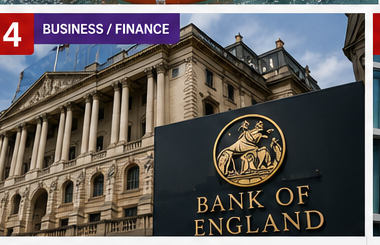
LONDON — The Bank of England is preparing to publish its next interest-rate decision and Monetary Policy Report on 30 July, with households, businesses and financial markets awaiting updated forecasts for inflation and economic growth.
The Bank has not announced the decision in advance. Its Monetary Policy Committee will publish the outcome alongside updated economic projections, followed by a press conference later that day.
The announcement will come shortly after the Bank's Financial Policy Committee concluded that the UK financial system remains resilient, including in the face of geopolitical disruption and volatile energy and interest-rate markets. UK households and businesses were described as broadly resilient, while banks were assessed as strong enough to continue supporting the economy during a severe stress.
Nevertheless, the Financial Stability Report identified several vulnerabilities. Valuations in risky assets remain stretched, pressure persists in sovereign-debt and private-credit markets, and the use of leverage in equity markets has increased significantly.
The Bank said global hedge funds' equity prime-brokerage balances had risen by around 40 per cent during the previous year. High leverage can magnify profits when markets rise, but it may also force rapid asset sales during periods of falling prices, increasing wider market instability.
Artificial-intelligence investment is another area under scrutiny. A relatively small number of AI-related companies have driven a significant share of recent equity-market growth, increasing concentration in major indices. The Bank warned that a reassessment of expected AI profits could result in sharp price corrections amplified by leverage and momentum-driven trading.
AI companies are also increasing their use of debt to finance data centres and supporting infrastructure. The risks are currently limited by the still-modest amount of outstanding debt, but the Bank says financing needs are growing quickly.
Frontier AI may also increase cyber and operational risks by enabling attackers to identify software vulnerabilities more rapidly. Financial institutions could benefit from AI-enabled defensive tools, but they must also manage dependence on technology providers and the risks associated with rushed system changes.
The Financial Stability Report should not be treated as a prediction of the Monetary Policy Committee's interest-rate decision. The two committees have different responsibilities.
Until the official announcement on 30 July, any report claiming that a rate decision has already been agreed should be treated as speculation.
Corrections & updates
- Story updatedAug 27, 2026, 1:52 PM
- Story published
Verified against the sources cited in this report.
Jul 24, 2026, 6:15 AM
Related stories

Global interest rates move higher as energy pressure complicates inflation fight
The US Federal Reserve stands at 3.75–4.00%, the Bank of Japan has raised rates to 1.25%, the Bank of England held at 3.75% by 6–3 and the ECB remains on a tightening path.

Anthropic considers new AI model amid safety debate and possible post-midterms IPO
The AI company is weighing a new model as competitive pressure grows; Ramp data indicates GPT-6 Astra has gained about 13% of enterprise AI spending.

ECB raises interest rates to 2.5% as energy shock revives inflation fears
The European Central Bank lifted its deposit rate by a quarter point, citing renewed energy costs feeding through to core prices across the euro area.